Tuesday, August 24, 2010

DNA Sequencing,The Procedure

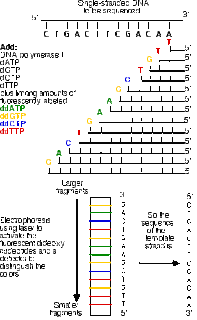
The DNA to be sequenced is prepared as a single strand.
This template DNA is supplied with
• a mixture of all four normal (deoxy) nucleotides in ample quantities
o dATP
o dGTP
o dCTP
o dTTP
• a mixture of all four dideoxynucleotides, each present in limiting quantities and each labeled with a "tag" that fluoresces a different color:
o ddATP
o ddGTP
o ddCTP
o ddTTP
• DNA polymerase I
Because all four normal nucleotides are present, chain elongation proceeds normally until, by chance, DNA polymerase inserts a dideoxy nucleotide (shown as colored letters) instead of the normal deoxynucleotide (shown as vertical lines). If the ratio of normal nucleotide to the dideoxy versions is high enough, some DNA strands will succeed in adding several hundred nucleotides before insertion of the dideoxy version halts the process.

Gene Expression

Gene expression is the process by which information from a gene is used in the synthesis of a functional gene product. These products are often proteins, but in non-protein coding genes such as rRNA genes or tRNA genes, the product is a functional RNA. The process of gene expression is used by all known life - eukaryotes (including multicellular organisms), prokaryotes (bacteria and archaea) and viruses - to generate the macromolecular machinery for life.

Several steps in the gene expression process may be modulated, including the transcription, RNA splicing, translation, and post-translational modification of a protein. Gene regulation gives the cell control over structure and function, and is the basis for cellular differentiation, morphogenesis and the versatility and adaptability of any organism. Gene regulation may also serve as a substrate for evolutionary change, since control of the timing, location, and amount of gene expression can have a profound effect on the functions (actions) of the gene in a cell or in a multi cellular organism.
In genetics gene expression is the most fundamental level at which genotype gives rise to the phenotype. The genetic code is "interpreted" by gene expression, and the properties of the expression products give rise to the organism's phenotype.

DNA Profiling Techniques - Techniques For All Occasions

Most of us are familiar with the use of DNA profiling in criminal cases and with the establishment of the National DNA Database as an investigative tool on the back of this. DNA profiling can provide a high degree of confidence that a particular body fluid stain, hair or flake of dandruff, for instance, could have been deposited by one particular person. Indeed, a substantial part of Forensic Access’s work involves checking the accuracy and relevance of DNA test results and assessing the sustainability of conclusions drawn in respect of them as to likely culpability in specific case circumstances.
But the same sorts of techniques can have much wider applications, and these are discussed in this issue of Benchmark.

Establishing paternity
DNA analysis has been used in numerous paternity cases and is usually pretty straightforward. But one of the most challenging cases we have dealt with dates back to the 1950s, and has extended the frontiers of forensic DNA analysis.
The case concerned a man who, relatively late in life, discovered that the man that he had always thought was his father might not have been. Both his mother and his putative father were dead by the time his suspicions were aroused and he had no real clues to go on. One possibility for his paternity appeared to be a man living overseas with whom his mother had corresponded. Analysis of DNA in saliva on the backs of postage stamps on mail found amongst his mother’s possessions had the potential to hold the key – saliva that had been deposited more than 50 years ago!
Standard techniques produced weak, incomplete profiles of the DNA. It was not possible to exclude either of the men on the basis of these profiles, so we decided to attempt a new form of profiling that analyses DNA on the male-specific Y chromosome only. Y-chromosome profiles are passed on pretty much intact from father to son for generation after generation and so can provide a particularly powerful means of establishing paternity. In this case, the Y-chromosome profiling showed that the recent information was incorrect and indicated strongly that his father had been the man he always thought he was.

Identifying bodies or body parts
Over the years we have been increasingly successful in establishing the identity of human remains by applying our ever more sensitive DNA extraction and profiling techniques to bones, teeth and hair in particular; for example, one of HM Coroners wanted confirmation that a body, the remains of which had been found hanging in a wood, was who it was suspected to be.
Similar techniques can be used to resolve medical disputes; for instance, in a case where it was suspected that a mastectomy had been performed on the wrong woman. This was confirmed by comparing the DNA profile of a sample of the biopsy tissue taken from the woman in question with the profile of the excised breast tissue. Unfortunately, there had been a critical mix-up of samples in the hospital concerned.

Claims for compensation
We are often asked to help with claims for compensation made against manufacturers or retailers that relate to ‘contaminated’ products, especially foodstuffs. Very often the contamination involves some sort of body fluid such as blood on the wrappings or on the product itself. We regularly find ourselves examining yogurt pots, sandwiches or even, as on a recent occasion, an ice cream cone with the ice cream still inside it. In many cases, the contamination turns out to have come from the consumer – but not always. In these circumstances we may be asked to advise as to where in the supply chain the contamination could have occurred.
Contamination or sabotage of manufacturing production lines
Internally generated incidents, where disaffected or disillusioned employees relieve themselves on or into products, spit chewing gum onto them or even include sanitary tampons or used condoms in them, affect manufacturers in a very immediate way.
In one case we distinguished ourselves by obtaining a full DNA profile from urine that had been used in this way. This was a remarkable feat since urine does not normally yield much in the way of DNA-containing cellular material.
Very often the knowledge that the manufacturer has the means to identify which staff member is responsible is sufficient to persuade the guilty party to put their hands up and/or to leave, without the rest of the workforce having to have their DNA taken to be checked against the offending sample. 

Hate mail and general harassment
Because it is usually difficult to handle something without leaving some trace on it, we have achieved considerable success with analysing so-called hate mail and other items sent through the post as part of campaigns of general harassment. With mail, we tend to look first for saliva on the backs of postage stamps and envelope flaps, but the process does not end there. Each case is different and may present opportunities for evidence other than DNA to be found, which enables items to be ‘clustered’ as having come from a common source. In these cases, DNA profiling tends to form just one prong of the overall investigative strategy, albeit a very important one.

Other types of case
There are many types of circumstance where DNA profiling has been instrumental in resolving suspicions or matters in dispute. One of the more unusual ones concerned a medical doctor whose excessive prescription of certain drugs had been noticed. As part of the investigation, his consulting room was searched and injection needles were recovered from several safety disposal bins. Twenty needles were submitted for examination and blood in 10 of them was sent for DNA analysis. All 10 needles generated DNA profiles that matched the doctor’s own DNA profile, and it became clear that he had been taking the drugs himself.
The essential message is that DNA profiling has a much wider application range than might be appreciated at first sight, and it is always worth asking if it might be capable of providing answers, however old or unusual the circumstances surrounding the question.
DNA Banking

Our DNA banking service provides organizations and private individuals with the peace of mind that comes from knowing that their DNA samples are stored in a safe and highly secured environment. Banked DNA may be used for future DNA tests, for example:
• To protect against illegitimate claims on an individual’s estate
• To provide a standard for comparison and identification of people in high-risk professions, such as men and women in the military, law enforcement personnel, firefighters, and overseas contractors
• To assist with the identification of missing persons or give clues about the trail of a missing loved one
• To identify inherited traits, such as genetic diseases and other physical characteristics
Stored DNA provides a genetic history that will become vitally important as the genomic puzzle is completed. DNA from an elderly parent could one day provide clues about inherited diseases and other genetic issues. Some day very soon, this type of family tree knowledge could prove lifesaving.
Our services are completely confidential. We only release information on banked DNA to persons you authorize. There are two service options for you to choose from:
• Chain of Custody DNA Banking
• Chain of Custody DNA Banking and Profiling
Chain of Custody DNA Banking
In Chain of Custody DNA Banking, DNA samples are collected and stored using a process that ensures courts and other government agencies will consider the results of any future DNA testing on the stored DNA.
In compliance with Chain of Custody procedures, your DNA sample will be collected by a trained professional. Your DNA collection appointment will be scheduled at a hospital or laboratory near you. Upon banking your DNA, we will provide you with a banking certificate stating the storage period (15 years), the names of persons you authorize to retrieve or use your samples, and other important information.

Paternity Test


DNA paternity testing determines whether a man could be the biological father of a child. We all inherit our DNA (the genetic material) from our biological parents. A DNA paternity test compares a child’s DNA pattern with that of the alleged father to check for evidence of this inheritance—the most definitive proof of a biological relationship.

The result of a DNA paternity test is either an exclusion (the alleged father is not the biological father), or an inclusion (the alleged father is considered the biological father). For a standard paternity test, DDC guarantees at least 99.99% probability of paternity for inclusions or 100% certainty of exclusion.
Test Types: Legal and Home DNA Test

The type of paternity test you need will depend on what you intend to use the DNA test results for:

• If you need paternity test results that can be used as a legal document (for example, to change the name on the birth certificate or to obtain child support and other benefits), a Legal DNA Test needs to be performed (described below). 

• However, if you need the test only for personal knowledge, a Home DNA Test willl suffice.
Unlike the Home DNA Test, where tested parties collect their own samples at their convenience, the Legal DNA Test follows a Chain of Custody documentation process to ensure that you receive accurate and legally defensible results. When you set up your case with DDC, we will coordinate a convenient sample collection appointment, during which a trained sample collector will complete all the necessary documentation to satisfy chain of custody requirements.

DNA Testing: The DDC Advantage
DDC leads the DNA testing industry in its quality of service, which focuses on ensuring DNA test accuracy as well as a smooth experience for our clients. For all our DNA paternity testing clients, we:
• Run each test twice, following the most stringent procedures to guarantee accurate and conclusive results.
• Complete testing in 3 working days (5 working days for a prenatal test).
• Maintain confidentiality of each case using strict communication protocols.
• Schedule convenient appointments through our comprehensive network of collection sites.
DNA Test Participants
In a standard DNA paternity test, the tested parties include a child, the alleged father, and the mother (called a trio).
The mother’s participation in the paternity test helps to exclude half of the child’s DNA, leaving the other half for comparison with the alleged father’s DNA. However, we can perform a paternity test without mother’s participation (called a motherless). A motherless test involves additional analysis, which DDC performs without any additional charge. Results are equally conclusive whether or not the mother participates. Motherless tests are guaranteed to have at least a 99.9% probability of paternity for inclusions and 100% for exclusion.

Can Stem Cells Mend a Broken Heart?: Stem Cells for the Future Treatment of Heart Disease

Stem cells are a class of undifferentiated cells that are able to differentiate into specialized cell types. Commonly, stem cells come from two main sources:

Embryos formed during the blastocyst phase of embryological development (embryonic stem cells) and

Adult tissue (adult stem cells)

Heart disease which includes hypertension, coronary heart disease, stroke, and congestive heart failure, has ranked as the number one cause of death in the United States every year since 1900 except 1918. Nearly 2600 Americans die of CVD each day, roughly one person every 34 seconds.

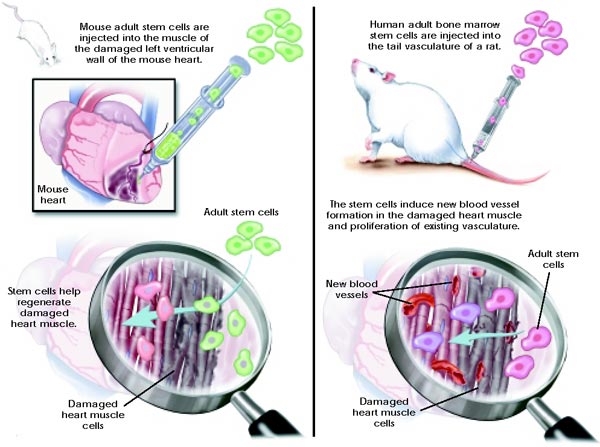
The use of embryonic and adult-derived stem cells for cardiac repair is an active area of research. A number of stem cell types, including embryonic stem (ES) cells, cardiac stem cells that naturally reside within the heart, myoblasts (muscle stem cells), adult bone marrow-derived cells including mesenchymal cells (bone marrow-derived cells that give rise to tissues such as muscle, bone, tendons, ligaments, and adipose tissue), endothelial progenitor cells (cells that give rise to the endothelium, the interior lining of blood vessels), and umbilical cord blood cells, have been investigated as possible sources for regenerating damaged heart tissue. All have been explored in mouse or rat models, and some have been tested in larger animal models, such as pigs.

Tissue regeneration is probably the most important possible application of stem cell research. Currently, organs must be donated and transplanted, but the demand for organs far exceeds supply. Stem cells could potentially be used to grow a particular type of tissue or organ if directed to differentiate in a certain way. Stem cells that lie just beneath the skin, for example, have been used to engineer new skin tissue that can be grafted on to burn victims.

What are the potential uses of human stem cells and the obstacles that must be overcome before these potential uses will be realized?

There are many ways in which human stem cells can be used in research and the clinic. Studies of human embryonic stem cells will yield information about the complex events that occur during human development. A primary goal of this work is to identify how undifferentiated stem cells become the differentiated cells that form the tissues and organs. Scientists know that turning genes on and off is central to this process. Some of the most serious medical conditions, such as cancer and birth defects, are due to abnormal cell division and differentiation. A more complete understanding of the genetic and molecular controls of these processes may yield information about how such diseases arise and suggest new strategies for therapy. Predictably controlling cell proliferation and differentiation requires additional basic research on the molecular and genetic signals that regulate cell division and specialization. While recent developments with iPS cells suggest some of the specific factors that may be involved, techniques must be devised to introduce these factors safely into the cells and control the processes that are induced by these factors.
Human stem cells could also be used to test new drugs. For example, new medications could be tested for safety on differentiated cells generated from human pluripotent cell lines. Other kinds of cell lines are already used in this way. Cancer cell lines, for example, are used to screen potential anti-tumor drugs. The availability of pluripotent stem cells would allow drug testing in a wider range of cell types. However, to screen drugs effectively, the conditions must be identical when comparing different drugs. Therefore, scientists will have to be able to precisely control the differentiation of stem cells into the specific cell type on which drugs will be tested. Current knowledge of the signals controlling differentiation falls short of being able to mimic these conditions precisely to generate pure populations of differentiated cells for each drug being tested.
Perhaps the most important potential application of human stem cells is the generation of cells and tissues that could be used for cell-based therapies. Today, donated organs and tissues are often used to replace ailing or destroyed tissue, but the need for transplantable tissues and organs far outweighs the available supply. Stem cells, directed to differentiate into specific cell types, offer the possibility of a renewable source of replacement cells and tissues to treat diseases including Alzheimer's diseases, spinal cord injury, stroke, burns, heart disease, diabetes, osteoarthritis, and rheumatoid arthritis.